
This problem with university professors is finally catching up to us.
Over-qualified, institutionally-marginalized, underpaid, but still central to student formation. A recipe for disaster.

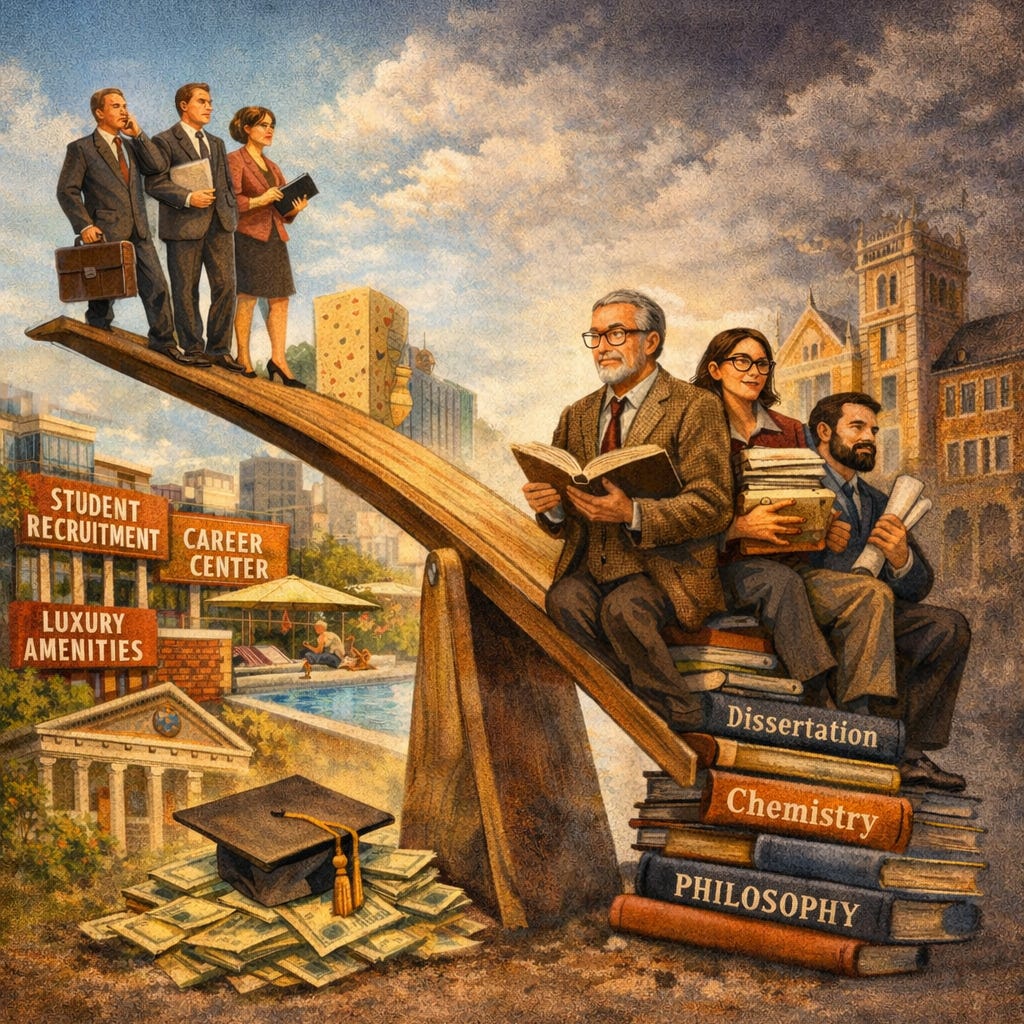
Universities are oddly shaped organizations. For many reasons. But one of the most prevalent is that a university’s main most critical employees are exceedingly over-qualified.
Talk to any professor about their work for just a few minutes, and you’ll see that this is true. Professors only scratch the surface of their subject, even with their most intellectually gifted students.
That’s what I mean by professors being over-qualified. They spend up to a decade studying a subject, and then they teach that subject to young adults who know very little about the subject. And this creates an odd organizational environment. Imagine you ran a mortgage company and had a 50-person sales team that consisted entirely of salespeople whose previous positions were in sales leadership — from sales managers and department leads, to Chief Customer Officers. What sort of dynamic would that create?
I’ll tell you what kind of dynamic it creates.
University professors routinely develop entitlement complexes.
And for good reason. Becoming a PhD is hard, and expensive. It takes a toll on marriages. It often causes women in doctoral programs to have children later than they want to. It creates depression, wanted relocation, stress, and enormous amounts of time. And that’s just during in the degree program itself. Ever since the mid 2000s, the academic job market has been so competitive that most PhDs are decidedly unlikely to land the traditional academic job that they expect. When I was a doctoral student from 2008 to 2012, I had friends who reported that their peers would sabotage one another — tearing pages out of library books that their fellow grad students needed to pass their exams, conveying false information to one another so that they’re articles would be rejected by publishers, competing with one another for their advisors’ attention.
Meanwhile, a PhD student is forced to specialize extremely narrowly. They carve out a brand for themselves in an incredibly competitive industry. My dissertation area was Shakespeare studies. I’d walk into the library (when people still did that) and stare with wonder at the shelves upon shelves upon shelves of academic publications on the works of William Shakespeare. How is one to find their own niche, their own original contribution to this centuries-long body of scholarship?
Admittedly, it’s somewhat different in the sciences because scientific research advances cumulatively and upon new knowledge and with new technology. But the point is that the process of earning a PhD is difficult. And not always in productive ways. It isn’t always the content of doctoral studies that poses the biggest challenge but the rigor of the game that you have to play to earn your degree with the kind of resume you need to get a job.
It’s no wonder that university professors have entitlement complexes. If someone is lucky enough to get a tenure-track job, then they’re constantly and acutely aware that they’ve earned it. They want a return on their investment. Professors don’t make much money. So the return they want is to be valued for their knowledge.
The problem is that there’s a severe misalignment between this return and the actual value professors’ provide to universities.
I’m talking about your average four-year or two-year university, the kind that 95% of professors teach in. The fact that professors invest so much time, money, and stress, and that they sacrifice communities, family, and mental health for the degrees they get means little to a university whose bottom line is measured by enrollment, endowment, and rankings.
Nor is a professor’s deep knowledge of their subject area indicative of the value they’re likely to bring. For example, I’ve witnessed absolutely no difference in quality of teaching between instructors with BAs, MAs, and PhDs. The factors that do tend to contribute to differences in quality are passion, affection for students, and general personability — in addition to some base level of general intelligence. But just as it is for a 6th Grade teacher, what makes a university professor effective in the classroom is their ability to connect with students interpersonally.
As a result of this misalignment between the investment that PhDs make in their education and the value they bring to universities is a perennial tension between administration and faculty. Faculty want more control over curriculum, student advising, and policies around hiring and promotion. They want unassailable job security in the form of tenure. They want lower teaching loads so they can do what they were trained to do (publish research). I’ve been in university Faculty Senate meetings where the faculty present official looking Resolutions (“Whereby … and whereby, … and whereby … We resolve…”) only for the administration to politely nod and shove it in their briefcase, destined to bank a 3-pointer into their office trashcan later that afternoon.
And therein lies one of the problems. PhD programs don’t teach doctoral students how to teach. They sort of teach someone how to be a scholar. But more than anything, they teach you how to be a grad student. They teach you how to conduct graduate research, how to align yourself strategically with the right faculty supervisors, how to plan and write a dissertation, how to network in the industry, and, especially since 2008, how to navigate the cutthroat academic job market.
Faculty respond to this misalignment of what they value and the value they bring to the institution in a few ways.
The Careerist. Some faculty take what I call the “careerist” route. They become department chairs, then deans, then provosts. All of these promotions move them farther and farther away from teaching as well as from the research they were trained to do. But in exchange they get higher pay and more influence. Careerists sometimes experience never judgment from their academic peers. It’s undeserved, but it makes organizational sense. They’ve gone to the “other side.” Furthermore, if you pay attention, you’ll notice that the careerists tend to come from Social Science related fields, especially Education, Psychology, Communication Studies, fields of study that fall outside the traditional liberal arts and sciences.
The Cultist. Other faculty retreat into whatever pocket they can carve out for themselves. Some of the best professors I’ve known operate their own little fiefdoms inside of universities. They secure for themselves a number of classes around subjects about which they’re passionate. They teach them well. And they build small cult followings of students. That’s not a bad situation. But the downside is that in order to do this — socially, organizationally, and psychologically — they have to ignore everything else happening in the university. The school might be cutting good programs, and impoverishing its Gen Ed requirements, and selling out to market trends to the detriment of students, but the Cultist doesn’t have the bandwidth to get involved. And even if they did, getting mixed up in institutional matters could put their fiefdom at risk.
The Idealist. And still other professors hold onto a romanticized ideal of the life of a university professor. They furnish their offices into cozy and decorated spaces. They dress the part every day. They diligently wait patiently for students to visit their office hours. They prepare meticulously for class. I admire the Idealist professor because they seek to actually enjoy their profession. These are the faculty who you’ll find after hours reading a book and scribbling notes, eager to share what they’re learning with others even if others aren’t listening. The problem the Idealist faces is fatigue because systemically the university does not value their enjoyment of learning. And they’ll experience this misalignment of values in areas of hiring and promotion, in the rollout of new institutional strategic plans, in frustrating performance review meetings where discussion centers on student feedback, and when they realize that they’ll never be able to afford to purchase a house.
There’s an institutional perspective to all this, of course.
Undergraduate students are a scarce commodity. And as a result, administrators have little reason to value the knowledge that faculty possess. To professors, their knowledge is their greatest value. But to their bosses, this knowledge is more of a box that needs to be ticked.
As organizations, universities invest most in academic support, admissions, financial aid officers, student experience amenities, counseling services, technology and learning platforms, time-to-degree efficiency measures, enrollment management, marketing, and whatever newest trend governs the arms race between universities. Just peruse your local four-year university’s job board, and you’ll see what I mean.
Student recruitment, retention, and matriculation are the university’s top priorities — and the wealth of knowledge that its professors possess is just one factor within this long list that advances these priorities.
And what’s more, disciplinary knowledge is one of the most abundant and flexible resources universities need. If you’re good at reading the college-going market, or if you have a proven track record of successfully applying for grants, or if you have an impressive portfolio for college marketing, then you’re a hot commodity. But if a History Professor retires, there will be literally hundreds of qualified applicants for the position.
It’s not universities’ fault that academic knowledge and teaching acumen are deprioritized or that professors are over-qualified. Or, at least it can be said that this is the industry that professors sign up for. That’s not to say that it isn’t a tragic situation … especially for students.
As usual, students are the ones who suffer the fallout.
The endemic over-qualification of university faculty creates a surplus. All universities have them. Google some random college in some random state. Choose a department a random, and read through their faculty profiles. You’ll probably find a list of accomplished teachers and scholars.
But this surplus does to the higher education industry what surpluses tend to do. It causes universities to compete with one another for students through different means than the quality of teaching faculty. And almost inevitably, these different means will be less advantageous for students. Every year or two, we see a new hot selling point that defines the university arms race. For a while it was resident life. At another time it was employability — investing in career centers and things like that, without the results to back up the claim. Globalization was the name of the game for a while. And then it was so-called “undergraduate research.”
There’s always something. But in the end, these activities and resources are secondary to the time that students spend with their professors.
That’s a bad recipe. Underpaid, over-qualified, under-resourced, institutionally-marginalized faculty … who are yet still the most important value-provider for the undergraduates that define a university’s success.
What strikes me is how often faculty distress gets psychologized or individualized when the issue is structural misalignment between institutional incentives and the actual labor of thinking, teaching, and advising. When systems are designed around revenue and optics, it’s not surprising that faculty expertise becomes simultaneously essential and devalued.
As a current philosophy PhD student, this read was both helpful and disheartening! Do you think what you're attempting to accomplish with Hildegard includes addressing this?